design-build-coordination · April 28, 2026 · 6 min read · Devin Osorio
Why Duct Sizing Matters Before HVAC Installation Starts
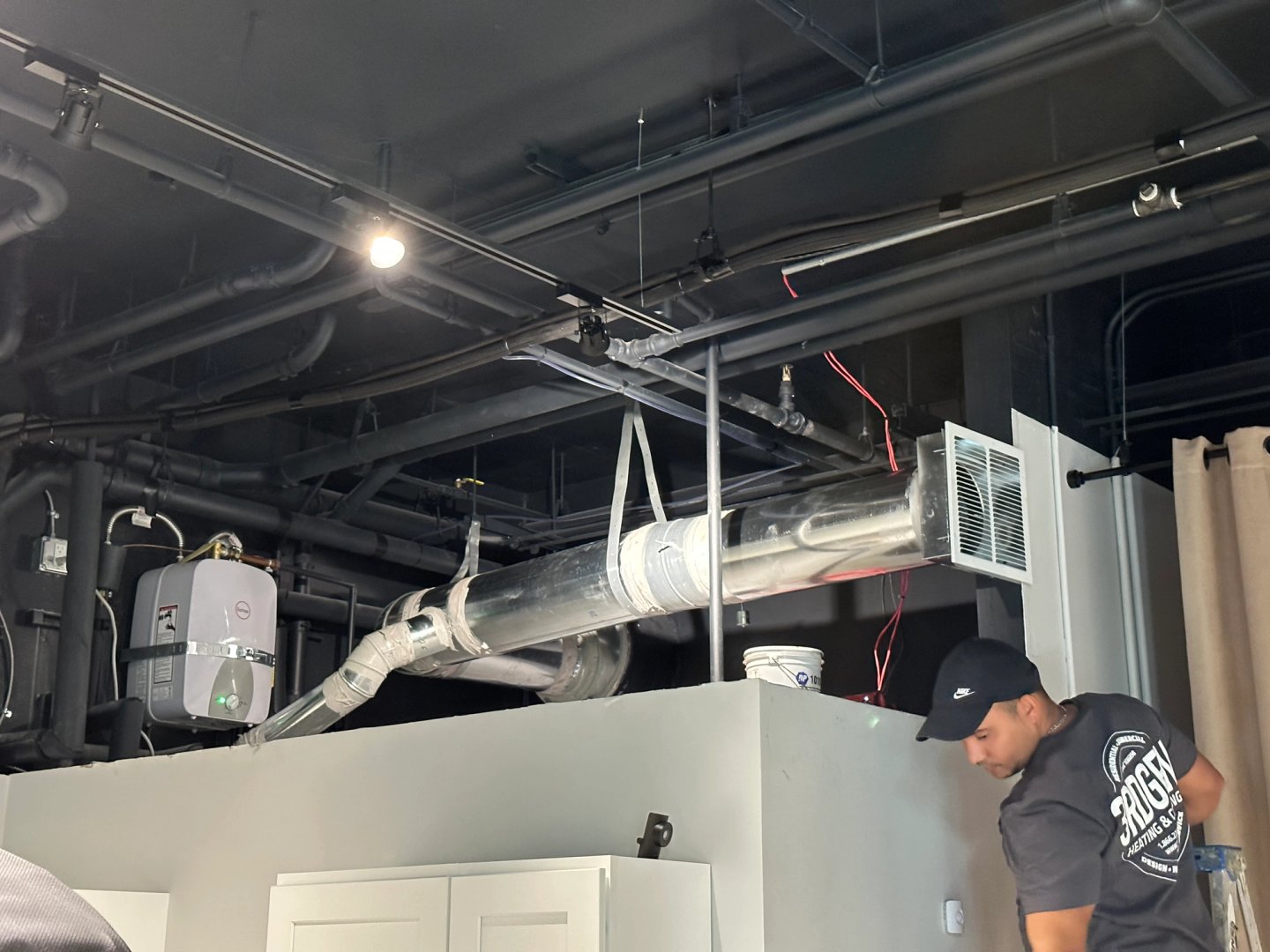
Duct sizing affects airflow, comfort, noise, and system performance long before installation starts.
Duct sizing is not just a sheet metal decision. It is one of the core design decisions that determines whether an HVAC system can actually move the right amount of air through a building.
A high-quality furnace, heat pump, fan coil, or air handler can still perform poorly if the duct system is undersized, poorly routed, noisy, leaky, or difficult to balance. The equipment may be capable. The installation may look clean. But if the ductwork does not support the required airflow, the system will struggle.
That is why duct design needs to happen before installation starts — not after the job is already framed, equipment has been selected, or ceiling space has disappeared.
Ductwork Has One Basic Job: Move the Right Air to the Right Places
At the simplest level, duct sizing starts with airflow. HVAC airflow is typically measured in cubic feet per minute, or CFM. Duct velocity is measured in feet per minute, or FPM.
The basic relationship is:
CFM = FPM × Duct Area
That means the same amount of air can be moved through different duct sizes, but not with the same result. A smaller duct forces the air to move faster. A larger duct allows the same airflow to move at a lower velocity.
That difference matters.
Higher velocity can increase pressure loss, noise, and fan energy. Lower velocity can reduce resistance, but oversized ducts may create coordination problems, cost issues, or fit conflicts with framing, ceilings, structure, lighting, plumbing, and other trades.
The goal is not simply bigger ducts. The goal is the right duct size for the airflow, space constraints, system type, and project conditions.
Bad Duct Sizing Shows Up as Comfort Problems
When ductwork is not sized correctly, the problems usually show up after the walls are closed and the system is running.
Common symptoms include rooms that never get enough heating or cooling, noisy supply registers, weak airflow at distant rooms, too much airflow near the equipment, high static pressure, equipment that runs longer than expected, uneven temperatures between rooms, return air problems, and systems that are hard to balance.
On residential remodels, this often happens when existing ductwork is reused without enough review. On commercial tenant improvements, it can happen when new layouts, ceilings, partitions, ventilation requirements, or occupancy changes are forced onto ductwork that was built for a different use.
In both cases, the issue is the same: the system is being asked to perform against ductwork that was not designed for the actual project.
Static Pressure Is Where Duct Problems Become Equipment Problems
Ductwork creates resistance. Fans have to overcome that resistance.
In HVAC design, that resistance is usually discussed as static pressure. The fan must move the required CFM while overcoming pressure losses from ductwork, fittings, filters, coils, grilles, dampers, and other components.
A duct system is not just straight duct. Every elbow, transition, takeoff, fitting, filter, coil, and grille adds resistance. That is where projects get into trouble.
A system can look reasonable on paper if only straight duct lengths are considered. But in the field, real duct systems include offsets, transitions, tight turns, takeoffs, and limited routing space. Those fittings have pressure losses too.
That is why a duct run with several tight turns may behave like a much longer duct run. The concept is called equivalent length: a fitting is treated as a certain number of feet of straight duct because it creates a similar pressure loss.
Ignoring equivalent length is one of the easiest ways to undersize ductwork.
Duct Shape Matters Too
Round, rectangular, and oval ducts do not perform the same way.
Round duct is generally more efficient because it has less surface area for the same airflow and lower resistance. Rectangular duct is often easier to fit into ceilings, walls, joist bays, and tight architectural conditions, but it can create higher pressure drop, more leakage points, and more fabrication complexity.
This matters constantly in Bay Area buildings.
Older homes, tight ceiling cavities, commercial interiors, tenant improvements, and remodels rarely give mechanical systems unlimited space. A design may need rectangular duct in one location, round duct in another, and careful transitions between the two.
The question is not just: will it fit?
The better question is: will it still move the required air once it fits?
Balancing Matters After Sizing
Even a reasonably sized duct system may need balancing.
Air follows the path of least resistance. If one branch has less resistance than another, it may receive more airflow than intended while another area gets less.
That is why duct design and field execution have to stay connected.
The design sets the intent. The installation has to preserve that intent. Startup and balancing confirm whether the system is actually delivering what the project needs.
Why This Matters for Remodels and Existing Buildings
Duct sizing is especially important in remodels and existing-building work because the mechanical system has to fit into constraints that already exist.
That may include existing framing, low ceiling areas, limited chases, old ductwork, architectural finish requirements, occupied-building conditions, equipment access limitations, structural restrictions, and coordination with electrical, plumbing, and fire systems.
That is the real-world part of duct design.
A duct system can be technically correct in isolation and still fail the project if it cannot be routed, accessed, installed, or coordinated with the rest of the building.
Where 3rdGen Fits In
3rdGen is built for mechanical scopes where these decisions matter before installation starts.
On residential projects, that may mean Manual J, Manual S, and Manual D support before equipment and duct decisions are locked in.
On commercial projects, it may mean reviewing plans, ceiling conditions, routing, equipment locations, ventilation, access, and coordination requirements before the field team is forced to solve everything during installation.
Good duct sizing is not just calculation. It is calculation plus project judgment.
The numbers matter. So do the building conditions, routing options, access requirements, equipment selection, and construction sequence.
That is the difference between installing HVAC equipment and delivering a mechanical system that actually fits the project.
When to Review Duct Sizing
Duct sizing should be reviewed early when a home is being remodeled, existing ductwork is being reused, a project is switching from gas equipment to heat pumps, a commercial space is being converted to a new use, a tenant improvement changes room layouts or occupancy, ceiling space is tight, or comfort complaints already exist in specific rooms or zones.
The earlier these questions are answered, the easier they are to solve.
Once framing, ceilings, finishes, and equipment locations are locked in, duct corrections become harder, more expensive, and more disruptive.
Final Takeaway
Duct sizing is one of the quiet parts of HVAC that determines whether the finished system feels right.
It affects airflow, comfort, static pressure, fan performance, noise, energy use, and long-term serviceability. It also affects coordination with the GC, architect, engineer, and other trades.
For project-based HVAC work, the best time to solve duct sizing is before installation starts.
That is where design-build mechanical planning earns its keep.